
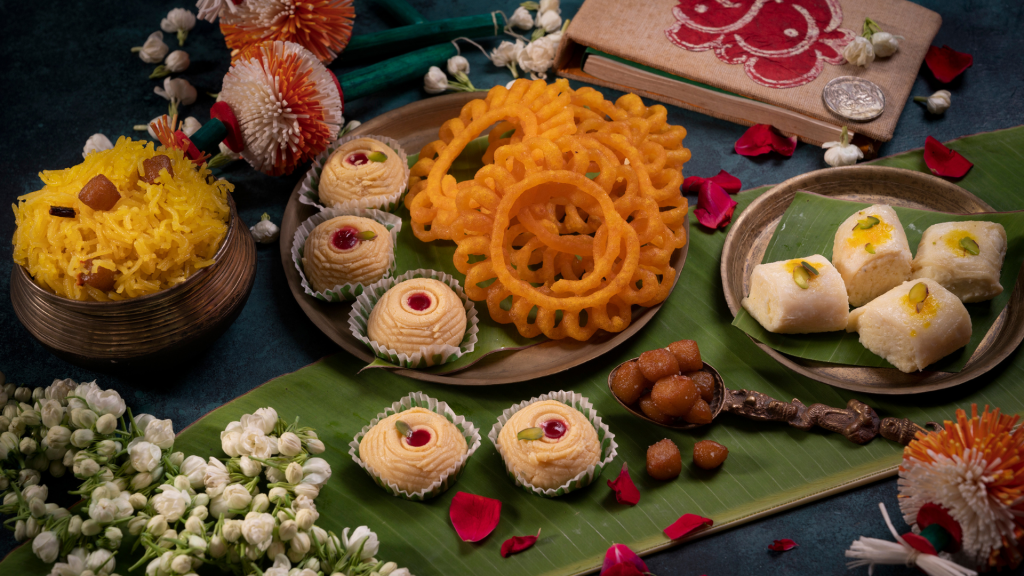
To bite into a piece of Sandesh is to taste a paradox — a confection that is both ephemeral and eternal. It dissolves on the tongue, yet its sweetness lingers, much like the stories we tell through food. In Bengali cinema, as in life, mishti (sweets) are not mere props; they are narrative alchemists, transforming sugar and milk into metaphors for love, loss, identity, and resistance. This is a cuisine that refuses to be trivialized as “dessert.” It demands to be seen as a language — a dialect of memory, a syntax of cultural survival.
Bengali sweets, with their velvety textures and caramelized depths, are as much about craft as they are about cosmology. Take Mishti Doi, the fermented yogurt dessert that balances tartness and sweetness in a single earthen pot. Its preparation — slow-cooked milk, jaggery, and the patient labor of fermentation — mirrors the rhythms of Bengali life: a blend of tradition and transformation. In film, this duality becomes cinematic. Imagine a scene where a grandmother prepares Mishti Doi in a crumbling ancestral home, her hands steady as she stirs the pot. The camera lingers on the curd’s golden surface, reflecting not just light but the weight of lineage. Here, the Doi is no longer food; it is a relic of resilience, a vessel carrying stories of partition, migration, and the stubborn refusal to let culture sour.
In Satyajit Ray’s Goopy Gyne Bagha Byne, the whimsical tale of a bumbling singer and his drummer companion, the Rosogolla is stripped of its regional strife and reimagined as a tool of transcendence. During their surreal adventures, Goopy and Bagha encounter a kingdom fractured by greed. In a pivotal scene, the duo — armed with magical powers granted by the King of Ghosts — present a platter of Rosogollas to warring factions. The sweets, glistening and impossibly spherical, defy the pettiness of human conflict. As the rivals bite into them, their scowls dissolve into childlike wonder, the syrup’s sweetness disarming hostility.
Here, the Rosogolla is no longer a subject of ownership but an agent of unity, its perfect roundness contrasting the jagged edges of discord. Ray’s films, layered with satire and fantasy, use the sweet to mock territorial pride — what are borders, the scene whispers, when shared joy can melt walls?
But let us not mistake symbolism for simplicity. Bengali sweets are fraught with contradictions, much like the culture they represent. Nolen Gur (date palm jaggery), the seasonal delicacy that flavors winter desserts, is a temporal paradox. It is harvested only in cold months, its scarcity making it precious. In film, this ingredient becomes a narrative device for exploring time. A character savoring Nolen Gur-er Sandesh in summer is not just breaking seasonal rules; they are defying fate, clinging to a sweetness that should have vanished. The act becomes rebellion — a culinary middle finger to entropy.
Humor, too, finds its way into this sugary semiotics. The Jolbhora Sondesh, a sweet filled with liquid jaggery, was allegedly invented as a prank — a culinary whoopee cushion meant to spray unsuspecting in-laws. In film, this mischief translates to subversion. A scene where a patriarch bites into a Jolbhora and splutters, his dignity dissolving along with the syrup, becomes a metaphor for toppling hierarchies. The sweet is a Trojan horse, smuggling irreverence into rigid traditions.
Yet for all their levity, these desserts carry the gravitas of history. The Sandesh, born from Portuguese influence on Bengali chhena-making, is a palimpsest of colonialism and adaptation. Its name means “message,” and in film, it often serves as one. In Antaheen (2009), a Sandesh delivered to a reclusive widow becomes her tether to the world — a edible epistle saying, “You are not alone.” The sweet’s delicate shape, molded by unseen hands, mirrors the fragility of human connection.
What makes Bengali cuisine uniquely cinematic is its intimacy with decay. Fermentation, after all, is controlled rot — a dance between creation and disintegration. Mishti Doi’s tang is the taste of time itself, a reminder that all things sour and sweet are transient. In Bariwali (2000), a filmmaker documenting a decaying mansion serves Doi to the caretaker’s daughter. The dessert, once a symbol of aristocratic opulence, now speaks of decline. The girl licks the pot clean, her hunger a stark contrast to the faded grandeur around her. Here, the Doi is not nostalgia; it is a critique — a spoonful of irony.
But let us not romanticize without reflection. The globalization of Bengali sweets — Cadbury Mishti, chocolate Sandesh — raises questions of authenticity. When a multinational corporation co-opts rosogollas for fusion desserts, is it innovation or erasure? In Kahaani (2012), a thriller set during Durga Puja, the protagonist eats a Rosogolla from a street vendor. The scene is brief, but the sweet’s ubiquity — its presence in slums and skyscrapers alike — hints at a culture commodified. Yet, the film resists cynicism; the Rosogolla remains unapologetically Bengali, its sweetness a defiant claim to identity in a homogenizing world.
Ultimately, the power of mishti in film lies in its ordinariness. These are not exotic delicacies but daily rituals — a Cham Cham shared between siblings, a Patishapta fried during monsoon rains. Their symbolism emerges not from grandeur but from repetition. In Pather Panchali (1955), Apu’s sister Durga steals a mango Sandesh, her guilt as palpable as the sweet’s crumpled foil. The act is trivial, yet it encapsulates childhood — the thrill of transgression, the ache of scarcity. When Durga dies, the uneaten Sandesh in her pocket becomes a relic, a testament to stolen innocence. Ray’s camera doesn’t linger on the sweet; it doesn’t need to. The audience tastes the loss in their bones.
To watch Bengali cinema without tasting its cuisine is to miss the subtext. The mishti is not garnish; it is grammar. It conjugates verbs of memory, declines nouns of identity. And in a world where cultures are flattened into Instagrammable trends, these sweets insist on complexity. They are sweet, yes, but never saccharine. They are stories — sticky, crumbling, fermented — demanding to be savored, not swallowed.
So the next time you see a Rosogolla on screen, do not dismiss it as a prop. See it for what it is: a universe in syrup, a rebellion in milk, a love letter written in sugar. And if you still don’t understand, take a bite. The film will taste better.
 ARTMO MAG
Leave a comment