
If history is written by the victors, Bengali cinema has long been the scribe of the vanquished, inking its narratives with the blood, sweat, and opium fumes of those crushed under the wheels of class. Here, satire is not merely a genre but a survival tactic—a way to laugh so you don’t weep at the cosmic joke of a society where a rickshaw puller’s sweat drips onto the polished Oxfords of the bureaucrat who’ll never notice him.
Consider the absurdist parable of Satyajit Ray’s Paras Pathar(1958), where a clerk’s discovery of the philosopher’s stone becomes less a fairy tale than a grotesque autopsy of capitalism’s false promises. Or the film, Ashani Sanket (1973), where the Bengal Famine of 1943 is framed not as a tragedy but a farce orchestrated by the deaf, dumb, and blind gods of caste and colonialism.
These films, like mischievous ghosts haunting the mansion of respectability, pull back the curtains to reveal the rot in the rafters—the structural inequities dressed up as destiny. Ray’s clerk, Paresh Chandra Dutta, doesn’t just turn iron into gold; he unwittingly holds up a funhouse mirror to a post-independence India drunk on the rhetoric of progress but stumbling over its own contradictions.
When Dutta’s wife, in her feverish ascent to socialite grandeur, serves pâté to guests who’d rather have pantua, the scene is both slapstick and sinister—a perfect metaphor for a nation trading its soul for a seat at the colonial table, only to realize the chairs are made of cardboard.
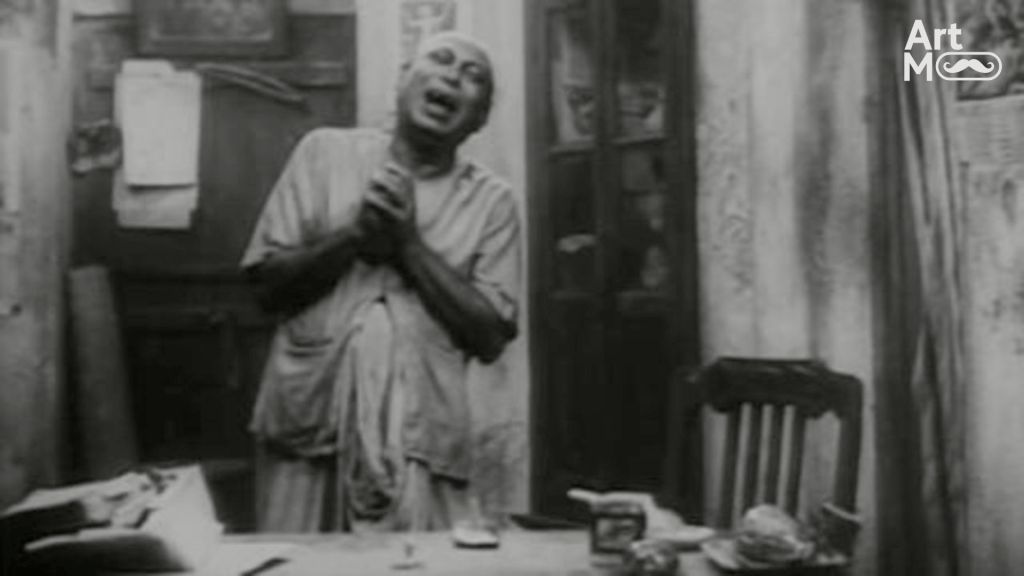
Paras Pathar, Ray’s first foray into comedy, is a fable of sudden wealth and moral decay that could easily be subtitled The Perils of Alchemy in a Postcolonial Economy. The protagonist, Paresh Chandra Dutta, is a lower-middle-class clerk whose life is a symphony of mundane compromises—until he stumbles upon a stone that transmutes metal into gold. What follows is a spiralling farce of nouveau riche excess, as Dutta’s windfall catapults him into a world of tailored suits, champagne fountains, and the sycophantic adoration of relatives who once regarded him as a footnote.
Ray, ever the humanist, infuses the satire with a touch of pathos: Dutta’s wide-eyed bewilderment at his own metamorphosis mirrors the disorientation of a society grappling with the seductions and perils of sudden modernity. The film’s genius lies in its inversion of the rags-to-riches trope; here, prosperity is not a reward for virtue but a catalyst for moral entropy.
Dutta’s gold, rather than elevating him, reduces him to a puppet of his own greed, dancing on strings pulled by a society equally intoxicated by wealth. The film’s release in 1958, a decade after India’s independence, resonates with the anxieties of a nascent republic navigating the pitfalls of capitalism and socialist idealism. Dutta’s trajectory—from clerk to caricature—mirrors the aspirations and disillusionments of a middle class caught between Gandhian austerity and the glittering promises of consumer culture.
Ray, never one to bludgeon his audience with dogma, lets the irony simmer: the philosopher’s stone, a mythical symbol of enlightenment, becomes here an emblem of spiritual poverty. The humor is bone-dry, laced with the absurdity of a man who, in gaining the world, loses his soul to a paperweight.
One can almost hear Ray chuckling behind the camera as Dutta’s wife, once content with modest domesticity, evolves into a parvenu hostess pratfalling over French hors d’oeuvres she cannot pronounce. It’s a comedy of errors where the biggest error is believing that class mobility is a ladder rather than a treadmill.
If Paras Pathar skewers the follies of aspiration, Satyajit Ray’s Ashani Sanket (1973) lays bare the necropolitics of neglect. Set against the backdrop of the 1943 Bengal Famine—a man-made catastrophe that starved three million while British colonials exported rice for the war effort—the film is a harrowing allegory of class as a lifeboat on a sinking ship.
Gangacharan, the village Brahmin played by Soumitra Chatterjee, begins as a benign figure, doling out homeopathic remedies and Sanskrit aphorisms to the rural poor. Yet as the famine tightens its grip, his privilege becomes a cocoon, insulating him from the desperation outside.
Ray’s camera lingers on surreal contrasts: Gangacharan’s wife grinding rice while skeletal figures haunt the periphery; a priest chanting hymns as mothers sell their daughters for sacks of grain. The satire here is glacial, its bite in the silence between words. When Gangacharan casually attributes the famine to “divine will,” the line lands like a hammer, encapsulating the blasphemy of caste complacency.
Ray avoids didacticism by grounding the horror in the mundane: a child’s bloated belly, a farmer eating mud to quell hunger pangs, a landlord haggling over grain prices while corpses pile up in the fields.
The Brahmin’s gradual awakening—a reluctant descent from denial to guilt—is less a redemption arc than a indictment of the myopia that conflates privilege with virtue. In one haunting scene, Gangacharan stumbles upon a village elder reciting the Chandi Purana, a hymn to the goddess of sustenance, even as his voice cracks with starvation. The dissonance—between sacred text and profane reality—is Ray’s coup de grâce: a society chanting to deities while its rulers play dice with human lives. What unites these films, across their tonal chasms, is their interrogation of complicity.
In Paras Pathar, the supporting cast—a circus of relatives, journalists, and opportunists—are not mere foils but accomplices in Dutta’s downfall, their greed a mirror to his own. Similarly, Ashani Sanket implicates not just the British Raj but the indigenous elite who weaponized caste to ration empathy.
This theme of collective guilt finds echoes in Ritwik Ghatak’s Subarnarekha (1965), where the trauma of Partition becomes a metaphor for societal rupture, or Aparna Sen’s Parama (1984), where a housewife’s awakening exposes the bourgeoisie’s suffocating scripts. Even in contemporary works like Qaushiq Mukherjee’s Gandu (2010), the rage of the underclass erupts in punk-rock nihilism, a far cry from Ray’s genteel irony but no less incisive.
To speak of Bengali cinema’s satire is to acknowledge its roots in a literary tradition that stretches from Bankim Chandra’s scabrous colonial critiques to Sharadindu Bandyopadhyay’s detective stories, where the solver of mysteries is often a bystander to larger societal crimes. Ray and Ghatak were all heirs to this legacy, blending the acuity of the Bengali Renaissance with the urgency of postcolonial critique.
In Paras Pathar, the philosopher’s stone is ultimately discarded, its magic revealed as a curse—a metaphor for the emptiness of material ascent. In Ashani Sanket, the final frames of Gangacharan walking through a desolate landscape, his sanctimony stripped bare, evoke a Job-like reckoning with a godless universe.
The humor in these narratives—often overlooked in favor of their pathos—is the humor of recognition, the uneasy laughter that comes from seeing oneself in the follies onscreen. When Dutta’s wife, in a fit of nouveau riche fervor, insists on serving “European-style” dishes to guests who’d prefer simple dal, the scene is as uproarious as it is tragicomic.
It’s a send-up of cultural cringe, yes, but also a reminder of how class aspiration often masquerades as cosmopolitanism. Similarly, Mrinal Sen’s depiction of a Marxist intellectual in Calcutta 71 (1972), pontificating about revolution between puffs of his pipe, is both a parody and a self-portrait—a wink at the bourgeois contradictions of radical chic.
In the end, what makes these films endure is their refusal to reduce class divide to a simplistic binary of oppressor and oppressed. Like Chekhovian dramas, they dwell in the gray zones, where good intentions curdle into hypocrisy, and privilege is often a matter of happenstance.
The Brahmin in Ashani Sanket is not a villain but a man sleepwalking through catastrophe, his caste a blindfold rather than a crown. Dutta’s tragedy is not his greed but his naïveté, the belief that wealth could insulate him from the moral quicksand of a stratified society. These characters, flawed and human, invite not just condemnation but empathy—a recognition of the systems that shape us all.
As contemporary India grapples with neoliberal excess and resurgent caste politics, the satires of Bengali cinema remain startlingly prescient. The philosopher’s stone, after all, is alive and well in the guise of cryptocurrency scams and instant celebrity. The distant thunder of inequality still rumbles, whether in farmer suicides or the glass fortresses of Gurgaon.
What Ray and their ilk understood—and what their films implore us to remember—is that class is not just an economic category but a collective fiction, sustained by myths of merit and divine ordination. To laugh at these myths, their work suggests, is the first step toward dismantling them. And in that laughter, uneasy though it may be, lies the glimmer of a more honest world.
 ARTMO MAG
Leave a comment