

Tarun Majumdar’s Shriman Prithviraj (1973) is a film that refuses to age, much like the stubborn idealism of its adolescent protagonist, Rashiklal Mukherjee, whose self‑bestowed title of “Prithviraj” becomes a metaphor for resistance against the absurdities of class hierarchies, colonial residues, and the bittersweet tyranny of growing up.
Set in rural Bengal on the eve of India’s freedom movement, the film is a masterclass in blending satire with sincerity, using the lens of childhood innocence to dissect the contradictions of a society caught between feudal traditions and the lingering shadows of British colonialism. Its genius lies not in grand polemics but in the quiet rebellion of a boy who, armed with a stick and a storybook, becomes an unwitting philosopher‑king of his own crumbling feudal universe.
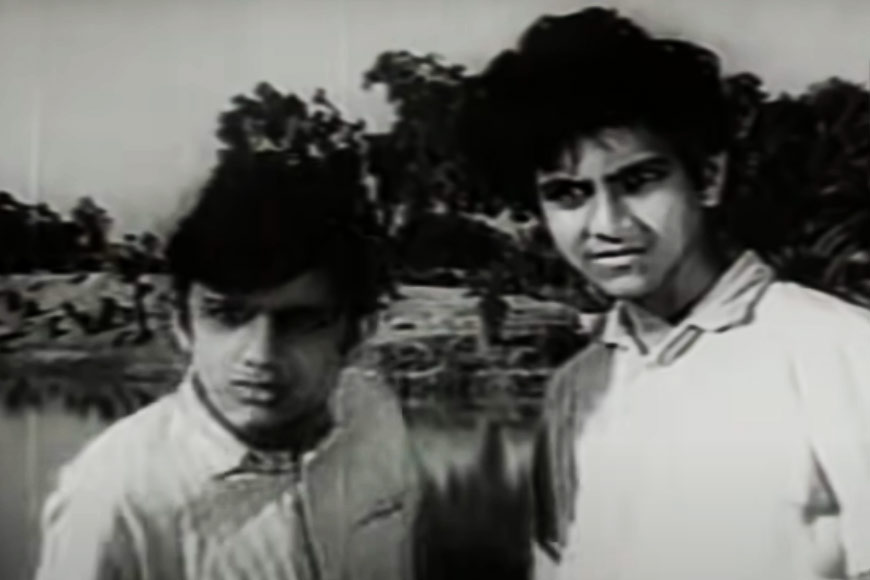
At its core, Shriman Prithviraj is a coming‑of‑age tale that subverts the genre. Rashik (Ayan Banerjee) is no bildungsroman hero striving for self‑actualization; he is a Tom Sawyer–esque prankster whose world is upended when his father, the well‑meaning but over‑zealous landlord Banamali Mukherjee (Satya Bandyopadhyay), decides to “tame” him through marriage.
Here, Majumdar exposes the absurdity of class performativity. The Mukherjees, like many zamindar families of post‑colonial Bengal, cling to antiquated customs—child marriage—as markers of status, even as these traditions unravel under the weight of their own contradictions. When Rashik’s misbehavior escalates from classroom pranks to a village‑wide escapade, the decision to marry him off feels less like discipline than a comic indictment of a society that confuses ceremony for character .
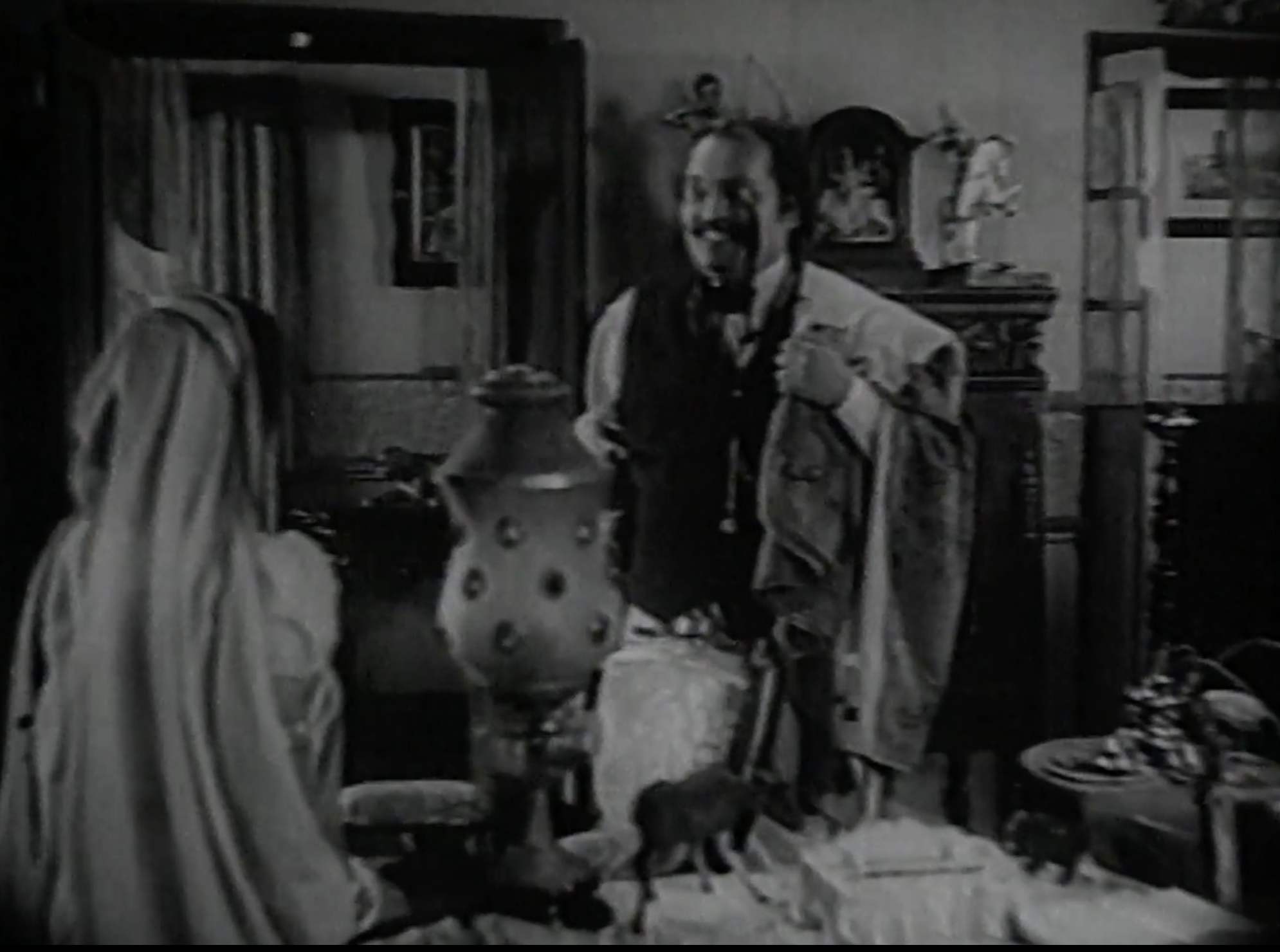
The colonial hangover manifests most vividly in Pannalal Roy Chowdhury (Utpal Dutt), Amalabala’s father, whose obsequious bowing to British officials is both tragic and farcical. His mangled English—deployed in scenes of frantic self‑promotion as he polishes his hopes for the Rai Bahadur title—is a metaphor for the self‑colonized mind.
In his desperate bid for colonial approval, Pannalal becomes a living relic of Macaulay’s “brown sahib,” a man so eager to erase his indigeneity that he willingly becomes a parody of the colonizer. Yet Majumdar refuses simplistic villainy; there is pathos in Pannalal’s folly, a reminder that the trauma of colonialism often expressed itself as self‑loathing mimicry .
Childhood, in Majumdar’s hands, becomes both sanctuary and battleground. Rashik’s gang of friends, self‑styled “adults” with their juvenile codes of honor, mirror the performative maturity of the colonial subjects around them. Their mock battles against the rival gang led by “Alexander” are farcical yet poignant.
When Rashik plans to flee to Tibet with a bag of puffed rice and iodine—believing the snowy peaks to be a short train ride away—the scene is less about childish naivety than about the human need to mythologize escape from societal cages. His eventual “growth” into marital responsibility—teaching Amalabala to place her feet on his boots in a gesture of timid intimacy—is not a surrender but a renegotiation. Rashik’s transition from prankster to protector is less about conforming to adulthood than about redefining it on his own terms, a quiet subversion of the patriarchal scripts handed to him .
The film does gently touch on nationalist sentiment through Akhil Mitra (Biswajit Chatterjee), Amalabala’s cousin, who espouses Swadeshi ideals in quiet asides. His devotion to boycotting British cloth and promoting village artisans lends an undercurrent of political consciousness, though it never descends into melodrama. There is no fugitive subplot here—Akhil’s revolutionary fervor is channeled through speeches at the village school and the humble act of swapping imported stationery for handmade paper .
Majumdar’s direction is steeped in literary richness, evoking the cadences of Bibhutibhushan Bandopadhyay’s pastoral nostalgia while infusing it with Satyajit Ray’s sharp humanism. The rural Bengal he paints—the emerald paddy fields, the crumbling havelis, the gossiping villagers—is neither romanticized nor condemned. It is a living ecosystem where tradition and modernity coexist in uneasy truce.

The scene where Rashik drives a vintage car at breakneck speed to “rescue” Amalabala becomes a metaphor for this collision: the machine, a symbol of colonial modernity, is hijacked by a boy whose very existence defies linear progress .
Philosophically, Shriman Prithviraj grapples with the paradox of freedom in a society still shackled by its past. Rashik’s rebellion is not against authority per se but against the absurdity of inherited hierarchies. His refusal to be molded into a “respectable” landlord’s son—whether through education, marriage, or social conformity—echoes Albert Camus’ assertion that “the only way to deal with an unfree world is to become so absolutely free that your very existence is an act of rebellion.”
Yet Majumdar avoids existential grandstanding; Rashik’s freedom is messy, comical, and deeply human. When he writes a letter to Amalabala peppered with kisses, scandalizing his friends, the moment is both a teenage awakening and a quiet revolution against the emotional austerity of his upbringing .
Class dynamics are etched with surgical precision. The Mukherjees’ zamindari, though decaying, still exerts a gravitational pull on the village’s social orbit. Banamali’s use of his son’s marriage as a tool for consolidating power sits in ironic counterpoint to the Swadeshi undercurrent that values self‑reliance over titles.
Even the film’s humor serves as class commentary: the family guru who insists on Rashik’s marriage is less a spiritual guide than a bureaucratic enforcer of social norms, a puppet master in saffron robes.
The film’s soundtrack, composed by Hemanta Mukherjee with lyrics by Gauriprasanna Mazumder, weaves class and culture into its narrative fabric. Yet Shriman Prithviraj never succumbs to didacticism. Its humor is intellectual without being pedantic: when Pannalal’s vintage car breaks down en route to a Swadeshi fair, and Rashik gleefully offers to fetch a bullock cart, the scene is both uproarious and pointed.
It reminds us that colonial infrastructure—roads, railways, bureaucracy—often served foreign interests, and that the simplest village technologies could upend imperial convenience. In this, Majumdar anticipates postcolonial critiques of development, suggesting that true progress must be measured in human terms rather than steel tracks.
Class, too, is interrogated beyond the colonial binary. The film subtly exposes the fissures within Indian society: the disdain of the babu for village simplicity, the condescension of the tutor toward Rashik’s idiomatic Bengali, the uneasy alliance between nationalist idealists and landed aristocrats. Majumdar allows these tensions to simmer without resolution, inviting the audience to reflect on the incomplete nature of freedom and the compromises it entails.
Philosophically, Shriman Prithviraj gestures toward a pedagogy of friendship. Rashik and Amalabala learn from each other: he, the joy of language and lore; she, the courage of mischief and spontaneity. Their relationship becomes a model for decolonized education, one based on mutual respect rather than authoritarian discipline.
When Amalabala teaches Rashik to write his own name in Bengali script, and he repays her by reciting verses of a folk song, we witness the fusion of personal affection and cultural affirmation. This interplay suggests that the most enduring anticolonial stance is not the rejection of English per se, but the affirmation of one’s mother tongue, traditions, and capacity for love.
Even today, more than fifty years after its release, Shriman Prithviraj resonates with audiences who recall their own childhood rebellions and first blushes of love. The laughter it evokes is never cheap; it springs from recognition—the recognition that childhood is at once innocent and subversive, that love can be a radical act, and that the hangovers of empire linger in the most mundane corners of daily life.
Majumdar offers no grand manifesto, no sweeping indictment of colonialism; rather, he invites us to witness a boy’s metamorphosis, to laugh at his follies, and to feel the stirrings of conscience that transform mischief into empathy. Class and colonialism are not abstractions but lived realities, woven into the fabric of education, marriage, and song.
Childhood is not a prelude to adulthood but a site of political awakening. And the hangover of empire, though potent, can be exorcised through the simplest acts of friendship, language, and laughter. In this way, Shriman Prithviraj remains as fresh as a schoolboy’s first prank—and as profound as any meditation on freedom.
 ARTMO MAG
Leave a comment