
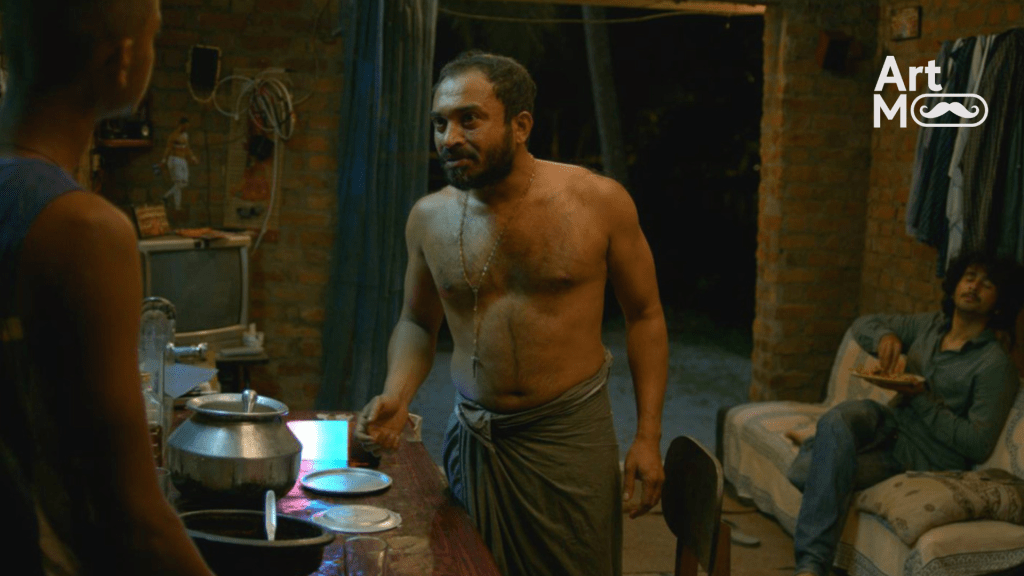
There is a certain kind of malaise one feels while watching a group of men try to bond in an average Indian film — that inevitable moment when one realises that these portrayals resemble a group of peacocks trying to out-scream each other rather than genuinely communicating. In that collective chaos, masculinity is often performed, never felt; it is barked, not whispered; it is worn as a chain around the neck, not carried as a gentle inheritance. Enter “Kumbalangi Nights” — a 2019 Malayalam film directed by Madhu C. Narayanan — a work so delicate in its treatment of male intimacy that it feels less like a cinematic narrative and more like a private diary found under a fisherman’s cot, smelling faintly of saltwater and melancholy. It dares to imagine men not as stoic sculptures of pride or testosterone marionettes, but as soft, liminal beings capable of tenderness, vulnerability, and silent transformations.
Set in the small fishing village of Kumbalangi, near Kochi, the film distills an ecosystem — a pungent blend of marshland sighs, half-finished homes, and a peculiar serenity that hides under the rotting fishnets. The four brothers at the film’s core — Saji, Bobby, Bonny, and Franky — inhabit a broken house that quite literally lacks walls, a beautifully literal metaphor for their emotional disarray. But more significantly, it embodies the possibility of rebuilding masculinity not through walls and fortresses, but through windows and porous borders. This open, fragmentary architecture of their home contrasts pointedly with the airtight, antiseptic home of Shammi (played with almost diabolical precision by Fahadh Faasil), whose house is as rigid as his moral code — a fortress to masculinity’s most toxic tendencies.
Historically, mainstream Indian cinema — even its so-called parallel or art-house branches — has rarely succeeded in portraying male tenderness without descending into homosocial farce or overwrought sentimentality. Male bonding is almost always defined by an undercurrent of violence or competition. Consider the drunken camaraderie in “Sholay” or the brooding male solitude in “Devdas.” The male friendships in these films exist but are burdened by an archaic vocabulary of stoicism. The men talk in slogans, not confessions. They share whiskey glasses and fight in climactic showdowns rather than share silences. “Kumbalangi Nights” shatters this mold by presenting us with men who are so imperfect and so unkempt that they become, ironically, truly alive. Their rawness is not aestheticised as rustic charm but shown as a daily condition of living in an India that is rapidly urbanising and swallowing its own intimate cultures.
Saji’s journey is particularly striking. After losing his friend in a moment of helplessness, he seeks therapy — a moment almost revolutionary for Indian male characters. This sequence is so unassuming and quiet that one might almost overlook its radicality. For an Indian man to cry in front of a therapist, let alone ask for help, is an act that transcends the cinematic. It becomes a small cultural insurrection. In a country where men are socialised into emotional constipation — told to “man up” and equate tears with weakness — Saji’s tearful breakdown is an act of reclamation. It asserts the right to pain without violence, to grief without self-destruction. To see him cook for his brothers later is a reclaiming of care as masculine labor. Cooking, in this film, is no longer a feminine adjunct to male heroism but a visceral act of emotional repair.
The brotherhood itself is remarkable in its unsmooth, stumbling honesty. The brothers are perpetually on the brink of collapse; they hurl insults and fish at each other with equal ease. And yet, there is a near-balletic choreography to their chaos. Bobby’s hesitant courtship of Baby becomes a subplot that underscores the film’s thematic concern with vulnerability. In contrast to Shammi’s suffocating patriarchal performance — his obsession with “being a man” — Bobby is tender, confused, and almost childlike. He represents a masculinity in transition, one trying to escape the inherited expectations and reach toward something gentler, something more human.
In creating Shammi, the film crafts perhaps one of Indian cinema’s most precise embodiments of toxic masculinity. He is outwardly impeccable: a well-groomed, overtly polite man who is so committed to the idea of being a “protector” that he ultimately becomes the true villain. Shammi’s surveillance over the women of his house and his pathological need for control embody a patriarchal anxiety that is widespread yet often normalised in Indian families. The brilliance of “Kumbalangi Nights” lies in its refusal to demonise its male characters wholesale. Only Shammi is depicted as truly dangerous, a cautionary relic of masculine ideals best left behind. The brothers, for all their faults, represent the evolving masculinity that seeks to understand itself rather than impose itself.
If we turn to other films attempting to portray male vulnerability, such as “Dil Chahta Hai” or “Rock On!!”, they tend to frame vulnerability as an episodic disturbance in otherwise robust lives. These films often resolve male conflict through external achievements — winning a race, reconciling in a group hug, singing a rock ballad — instead of confronting internal frailty as a permanent condition. “Kumbalangi Nights” refuses such narrative conveniences. The brothers remain poor, emotionally handicapped, and socially marginal even at the end. There is no miraculous career breakthrough, no sudden move to a cosmopolitan apartment with a bar counter and pastel walls. Their arc is not about escaping their world but about learning to live within it, with dignity and mutual care.
Perhaps the most poetic metaphor is the house they inhabit, which they eventually begin to mend. Walls are erected slowly, but not to keep the world out — rather, to create a more inhabitable inner world. The home’s gradual completion echoes the brothers’ emotional repair. It is no coincidence that the film ends on a meal being prepared, suggesting a future built not on masculine conquests but on shared nourishment. Even the sea that laps at their home becomes a character — a witness to their failures and rebirths, an echo of Kerala’s coastal history where water is both life-giver and destroyer.
This redefinition of masculinity is not an isolated cinematic event but part of a broader social undercurrent in Kerala, a state known for its progressive politics yet struggling with entrenched gender norms. The film subtly references the state’s high rates of domestic violence and alcoholism, issues that remain taboo despite the state’s otherwise impressive human development indices. By situating the story within this context, “Kumbalangi Nights” becomes both a mirror and a gentle rebuke.
One might say the film is what Tagore would have called “the gradual unfolding of truth through intimate spaces.” Indeed, it refuses spectacle and embraces the minute — a trembling lip, a hesitant hand on the shoulder, a quiet moment of fish curry preparation — as its emotional epicenter. It is no longer about the alpha male proving himself but about flawed men stumbling toward each other in a perpetual dance of forgiveness. It insists that masculinity can be beautiful in its vulnerability, that brotherhood need not be a fortress of shared aggression but can be a greenhouse of shared growth.
If the classical Indian male hero is like a rigid Kathakali dancer, heavily painted and codified, the men of “Kumbalangi Nights” are more like Mohiniyattam performers — fluid, soft, and circular, unafraid to curve inward. In a country where men are socialised to move linearly toward dominance, these brothers wander, meander, sometimes collapse — and therein lies their charm.
At a time when mainstream cinema still profits from masculine chest-thumping (consider the endless parade of pan-Indian “mass” films), “Kumbalangi Nights” chooses instead to slip into the backwaters, listening to crickets, nurturing silences. In doing so, it redefines not only what it means to be a brother but what it means to be a man. It does not offer easy answers or melodramatic resolutions. Instead, it provides something more radical: the possibility of men existing outside performative machismo, of masculinity as something earned rather than announced, whispered rather than screamed.
In the end, the film leaves us with a vision of masculinity that is as haunting as it is hopeful. It offers an invitation to the Indian male: to dare to be incomplete, to ask for help without apology, and to rebuild walls not to defend, but to welcome. It asks us, with a wry smile, “What if the real revolution was not to raise your fists, but to simply open your arms?”
 ARTMO MAG
Leave a comment