
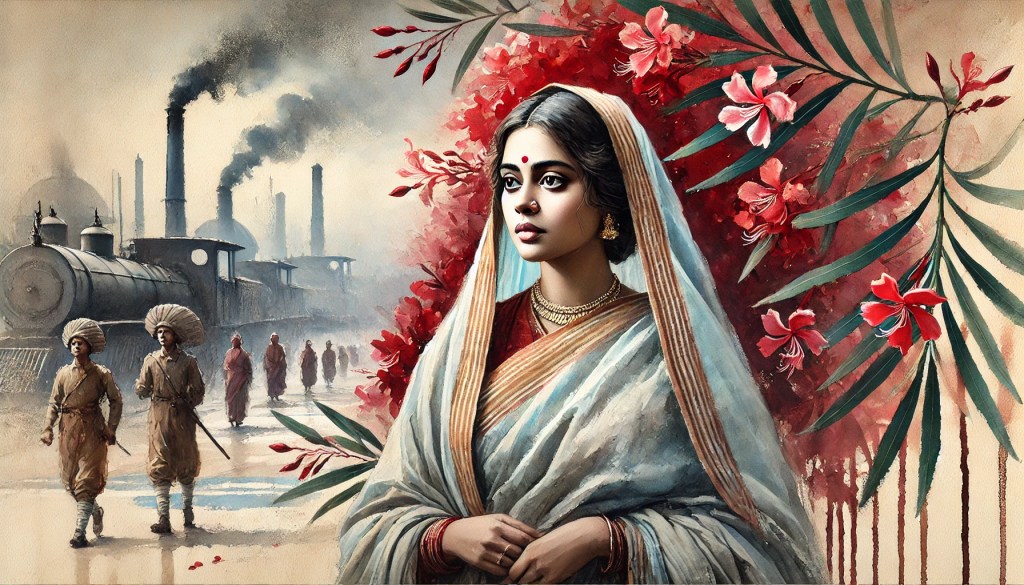
Having grown up in a quintessential Bengali household, participation in Natok during the Durga Puja festivities was not merely a tradition for me—it was, in fact, a rite of passage. The stage, for as long as I can remember, has been my sanctum, where culture, art, and identity come together in their most vibrant form. Since my childhood, I have been a part of innumerable Natoks during Pujo, donning both lead and supporting roles. Each year, an air of palpable excitement would envelop Pusa Campus as friends, family, and neighbors gathered—drawn by an unspoken yet profound desire to reconnect with one another and immerse themselves in the rich cultural legacy of Bengali theater. Whether as actors or spectators, the act of coming together in such shared artistic expression was nothing short of a collective homecoming.
Now, as the years have passed and life has led me down different paths, the opportunity to return to the stage has grown scarce. And yet, my mind often drifts back to those golden days, thinking of the wonderful souls who took upon themselves the task of curating and directing the plays that became the heart of our Pujo celebrations. From the early days of performing under the meticulous direction of Mandira aunty, to later being a part of productions helmed by the ever-spirited Kajal uncle, I have witnessed and absorbed so much. With each role I played, each story I enacted, I came to understand not only the craft of theater but also the deeper resonances of the texts we brought to life.
Today, at the age of 27, armed with these experiences, I find myself delving further into the vast expanse of Bengali literature—exploring the works of the playwrights, writers, filmmakers, and artists who shaped our cultural identity, their timeless words offering new insights with each reading.
In my recent explorations, one play caught my attention in particular—Raktakarabi, a work penned by the towering figure of Bengali letters, Rabindranath Tagore. Raktakarabi, penned in 1924, stands as one of his most profound and complex works. It is a play steeped in symbolism, a piece that critiques the dehumanization brought about by industrialization and authoritarianism. The play has captivated readers, scholars, and theatregoers alike for nearly a century, its themes remaining as relevant today as they were during Tagore’s time.
The story of Raktakarabi is set in the fictional city of Yaksha Town, a place suffused with allegory, where labor and machinery have enslaved humanity to the pursuit of wealth. The city is ruled by a faceless, omnipresent King, who controls every aspect of life from behind the shadows of his palace, symbolizing the cold, impersonal power of capitalism and the mechanized state. The residents of Yaksha Town live in the shadow of the King, their existence reduced to mindless toil as they dig relentlessly for gold in the mines, feeding the ever-hungry coffers of the ruler.
At the heart of the play stands the character of Nandini, a young woman of remarkable beauty, spirit, and freedom. Her very presence introduces a stark contrast to the grim, oppressive world of Yaksha Town. Nandini represents life, nature, and the spirit of humanity that refuses to be subsumed by the tyranny of systems and machines. She arrives in the city, radiant with hope and the promise of liberation, igniting a spark of rebellion in the hearts of the workers. Her relationship with Ranjan, a figure from her past and a symbol of human love and connection, further deepens the thematic layers of the play.
Nandini’s role in the narrative is pivotal, not just as a person, but also as a symbol. She embodies the essential human qualities that the world of Yaksha Town seeks to suppress—emotion, beauty, and freedom. As she enters the city, she brings with her the promise of redemption, an almost messianic figure who challenges the mechanical, soulless existence of the miners. In many ways, Nandini is the Raktakarabi (red oleander), a flower that grows in the barren, oppressive landscape, a symbol of both love and resistance. Her mere presence offers an alternative to the hollow pursuit of wealth, but at the same time, her radiance makes her a target for the King’s insidious control.
What is striking about Raktakarabi is how deeply rooted it is in Tagore’s critique of modernity. Much like his other works, this play is not simply a political statement but an exploration of human existence and its relationship to power, freedom, and nature. Tagore, who had been closely observing the rise of industrialization in both the West and in India, saw in it not only the potential for material advancement but also the risk of a profound spiritual and emotional decline. In Raktakarabi, he portrays this dystopian vision in the form of Yaksha Town, where the soul of humanity is crushed beneath the wheels of an unrelenting machine.
Tagore’s King is a particularly intriguing character, and one who doesn’t fit neatly into the mold of a traditional antagonist. He is not a villain in the personal sense, but rather a force—an embodiment of the impersonal systems of power that dominate the world. Throughout the play, the King remains unseen, ruling from behind a screen, his presence felt in every corner of Yaksha Town but never directly confronted. This facelessness is key to understanding Tagore’s critique: the King is not an individual tyrant, but a symbol of the invisible mechanisms of power—capitalism, industrialization, and colonialism—that control society from afar, stripping individuals of their humanity.
The contrast between Nandini and the King creates the central tension in the play. While the King’s power is hidden, diffuse, and impersonal, Nandini’s is direct, emotional, and deeply human. Her arrival in Yaksha Town catalyzes a crisis, not only for the miners but for the King himself. Through her, Tagore introduces a profound philosophical question: what does it mean to be free? Is freedom simply the absence of chains, or is it something more—a deep connection with nature, with love, and with one’s own humanity? In the world of Raktakarabi, it becomes clear that true freedom is not merely physical, but spiritual. It is the freedom to feel, to love, and to live fully, qualities that Nandini represents in the face of the King’s dehumanizing regime.
As the play unfolds, it becomes clear that the struggle between Nandini and the King is not merely a political one, but a metaphysical battle for the soul of humanity. The miners, who toil endlessly for gold, are slowly awakening to the possibility of a life beyond the mine, a life in which they can reclaim their humanity. Nandini’s influence awakens a sense of rebellion in them, but not in the violent sense. Instead, she stirs within them the desire for something more than material wealth—something more than the narrow existence that Yaksha Town offers.
However, the conclusion of Raktakarabi is not a simple resolution of these tensions. In true Tagorean fashion, the play’s ending is ambiguous, resisting the temptation of a clean, triumphant conclusion. Nandini’s ultimate fate—whether she brings about the liberation of the miners or is herself destroyed by the system—is left open to interpretation. This ambiguity is perhaps the most powerful aspect of the play, as it reflects the complexity of the struggle for human dignity in a world dominated by impersonal forces.
Raktakarabi remains, to this day, a powerful meditation on the nature of freedom and the costs of industrialization. It speaks to the ongoing tension between the mechanization of society and the resilience of the human spirit, themes that are as relevant in the 21st century as they were in Tagore’s time. The play’s brilliance lies in its ability to operate on multiple levels: as a social critique, a philosophical exploration, and an emotional drama. It transcends the specific political and economic conditions of its time, offering a timeless reflection on the struggles of humanity to remain whole in the face of overwhelming forces that seek to fragment and control.
In reflecting upon this particular work, it is impossible to overlook Tagore’s mastery of symbolism and his deep humanism. The play is not merely a cautionary tale about the dangers of industrialization; it is an impassioned plea for the preservation of humanity’s essential qualities—love, freedom, and the beauty of existence. As we navigate an increasingly mechanized and digitized world, Raktakarabi continues to resonate, reminding us that at the heart of every system and structure must be the recognition of our shared humanity.

 ARTMO MAG
Leave a reply to Nirmalya Chakrabarty Cancel reply