
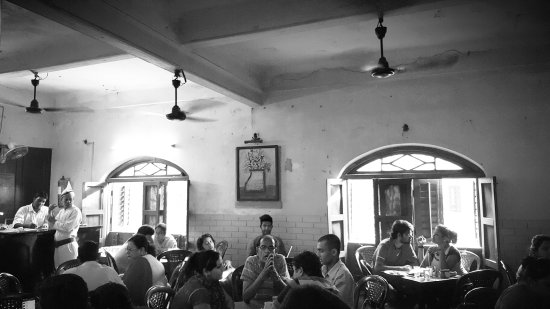
If you have ever wandered into the streets of Kolkata — past the bookshops that lean precariously like old scholars and the tea stalls that exude the aroma of cardamom and dissent — you may have stumbled upon an adda. Not stumbled into, mind you; one does not casually intrude on an adda. Like a firefly circle glowing in the gloam, it is a spectacle you observe, and if lucky, enter with caution and reverence. The adda is no mere discussion. It is a living, breathing institution that has, over decades, shaped the intellectual and literary climate of Bengal. To speak of Bengal without mentioning adda is like describing Athens without the agora or Renaissance Florence without its salons. It is in these smoky corners and worn-out benches that Bengal’s most irreverent questions and transcendent ideas have been born.
The essence of an adda is its delightful refusal to be productive in any conventional sense. Gather a handful of individuals, often of varying intellectual proclivities, and let them loose on a topic — politics, Tagore, the cosmos, or the suspiciously small size of the local singara. An adda is not goal-oriented; its purpose lies in its purposelessness. Paradoxically, it is this aimless meandering that fosters critical thinking. Unlike structured debates, where each point is sharpened to skewer an opponent, the adda allows thoughts to breathe, wander, and often stumble upon unexpected insights.
Adda has always been egalitarian in spirit. It does not discriminate by age, class, or expertise. A college student armed with fiery idealism may lock horns with a retired bureaucrat whose cynicism has been honed by decades of governmental drudgery. A poet might propose a grand theory of art only to be brought crashing down to earth by a factory worker who declares, “But if I cannot eat your poetry, what use is it?” This collision of perspectives, often interspersed with loud laughter and the occasional heated retort, is the crucible where ideas are forged. In its way, the adda is an anti-hierarchy. Titles, degrees, and positions are checked at the metaphorical door (though real doors are rarely involved — most addas take place in public or semi-public spaces). What remains is the merit of one’s wit, the sharpness of one’s argument, and the ability to survive a storm of well-meaning ridicule.
History reveals that many of Bengal’s literary and intellectual movements found their spark in addas. The Hungry Generation poets of the 1960s, who rejected the genteel aesthetics of previous Bengali poetry, were known for their fiery gatherings in Kolkata’s coffee houses. These weren’t just brainstorming sessions; they were chaotic battlegrounds where language was stripped bare, reassembled, and baptized anew. Sunil Gangopadhyay, a leading voice of this movement, once remarked that their poetry was as much the result of arguments over endless cups of tea as it was of solitary inspiration.
The adda is not merely a historical artifact; it is a living tradition that has adapted to the times. Today, the quintessential Bengali adda has found new homes in WhatsApp groups, Facebook comment threads, and Twitter debates. While the digital realm lacks the tactile warmth of a clay tea cup and the intimacy of shared physical space, it retains the spirit of intellectual camaraderie and spirited dissent. That said, purists will argue — not without reason — that no emoji can capture the conspiratorial grin of a friend who’s about to deliver the ultimate zinger in a face-to-face adda.
To understand why adda fosters critical thinking, one must delve into its peculiar rhythm. An adda ebbs and flows; it is not a tightly wound clockwork but a lazy river. It allows for interruptions, digressions, and the occasional philosophical epiphany inspired by something as mundane as a pigeon’s ungainly landing. The lack of structure is its structure. This openness creates a safe space where individuals can articulate half-formed ideas without fear of judgment. In turn, these nascent thoughts are scrutinized, expanded upon, or gleefully dismantled by others. What emerges is not consensus but a kaleidoscope of perspectives — each fragment enriching the whole.
But let us not romanticize the adda beyond recognition. It has its flaws. Like any institution, it can become insular, a gathering of like-minded individuals unwilling to challenge their own assumptions. Worse, it can devolve into an echo chamber of nostalgia, where participants lament the decline of civilization while doing little to address it. Yet even in its most self-indulgent moments, the adda remains a celebration of dialogue, a tribute to the human need to connect through conversation.
What truly sets the adda apart is its interplay of the mundane and the profound. In a single session, participants may leap from debating the existential implications of quantum physics to discussing the merits of the local sweet shop’s Rosogolla. This oscillation between high and low culture is not a bug but a feature. It reflects an essential truth about human creativity: the most groundbreaking ideas often emerge not from solemn contemplation but from the joyous chaos of shared laughter and irreverence.
In a world increasingly obsessed with efficiency and outcomes, the adda stands as a quiet act of rebellion. It refuses to be commodified or streamlined. It is, in its essence, a celebration of the art of being over the tyranny of doing. Perhaps this is why it continues to endure, even as traditional spaces for dialogue shrink. The adda is not merely a cultural phenomenon; it is a philosophy, a way of engaging with the world that values curiosity over certainty and connection over competition.
So the next time you find yourself in Bengal, seek out an adda. Bring your opinions, your doubts, and your sense of humor. Leave your ego at the door. And if you find yourself locked in a spirited debate about the semiotics of Tagore’s Gitanjali or the proper way to prepare Ilish maachh, remember: you are not just participating in a conversation. You are partaking in a legacy that has shaped one of the richest intellectual traditions in the world. And if nothing else, you will leave with a full heart, a sharper mind, and the lingering taste of tea — the unofficial fuel of the adda.


 ARTMO MAG
Leave a reply to Admin Cancel reply